Common Foot Injuries

Visit us for a comprehensive diagnosis and personalised treatment plan.

Common Foot Injuries

Our feet, together with our hands, make up more than half the bones in our body. The feet’s tendons, muscles and ligaments work together to support our weight and are necessary to get us around, be it walking or running. However, we may experience foot conditions due to sports injuries or overuse.

common foot injuries - Oxford Orthopaedics

Lisfranc Injury

Lisfranc Injury - Oxford Orthopaedics

The foot is an intricate structure containing many bones, held stably in place by ligaments, tendons and muscles.  The Lisfranc ligament is a complex and tough structure that connects the rays of the first and second toes (through the medial cuneiform and second metatarsal), providing support and stability to the midfoot.

A Lisfranc injury is a dislocation-type injury to the foot that is often associated with foot fractures.  In simple terms, a fracture-dislocation means that the foot bones are pushed out of alignment, and in more serious injuries, there may be concomitant fractures of the foot bones.  It is typically caused by a twisting injury applied to an axially loaded foot (see diagram above, left), for example in trampoline activities, contact sports and fall from height injuries, leading to a traumatic disruption of the Lisfranc ligament.  Disruption of the Lisfranc ligament can also occur from seemingly trivial “foot sprains”, such as twisting of the foot on a slippery wet floor in the bathroom.

Lisfranc injuries happen when a large amount of twisting force is applied to the midfoot, and most commonly occur due to trauma and sports. The causes can be broadly divided into high-energy and low-energy mechanisms.

Examples of high-energy injuries include:

Low-energy injuries include:

The most common symptoms of Lisfranc injuries include:

In high-energy Lisfranc injuries, there may be additional external injuries, severe swelling and more pain as compared to low-energy injuries.  High energy Lisfranc injuries are associated with multiple patterns of foot fracture-dislocation, including multiple metatarsal, cuneiform and cuboid fractures.

How is a Lisfranc injury diagnosed?

Your doctor will ask you some questions about the mode of injury and your symptoms, as well as examine your injured foot thoroughly for tenderness over the Lisfranc ligament, degree of foot swelling (surgery is only performed after swelling has subsided), and any deformities unique to this injury (abnormal widening of the foot, bruising on the sole).

Lisfranc injuries may sometimes be misdiagnosed as ankle sprains, and there may be other concomitant foot injuries.  Additional radiological imaging such as a weight bearing X-rays of the feet, MRI scans and CT scans may be required to confirm the diagnosis, search for associated injuries, and aid in pre-operative planning.  Such scans will also assist your doctor in crafting an appropriate overall long-term treatment plan.

ankle pain - Oxford Orthopaedics

How is it treated?

The treatment of Lisfranc injuries depends on severity – less severe injuries with no shifting of the bones (undisplaced) can be conservatively managed with casting, painkillers, and avoiding weight bearing for approximately 6-8 weeks.

More severe injuries are common, however, and typically require surgery.  For displaced bony Lisfranc injuries (involving both dislocation and fractures), open reduction and internal fixation with plates and screws remains the operation of choice.  For purely ligamentous Lisfranc injuries (i.e. dislocation without any foot fractures), the preferred option is midfoot fusion surgery by joining the affected bones of the midfoot with plates and screws.  In cases where there is extensive injury to the midfoot, an external fixator may need to be applied temporarily until the skin wounds heal and the soft tissue swelling subsides, before proceeding with the definitive surgery options discussed above.

To promote healing and prevent further injury, you will be kept on non-weightbearing to the affected foot for approximately 6 weeks after your surgery.  It is important to note that, for displaced Lisfranc injuries, early surgery is essential for providing the best chance for bone and ligament healing in the short term, and for minimising the risk of early-onset midfoot arthritis in the long-term.  Your surgeon will discuss the treatment options with you and advise you on the most suitable surgery.


Complications

As with any injury, even after you’ve recovered, there may be some long-term complications, such as:

ankle sprain healing timeline

Metatarsal Fracture

Metatarsal Fracture - Oxford Orthopaedics

You have five metatarsal bones in each foot, spanning the length of the midfoot till the base of each toe.  A metatarsal fracture involves a complete or partial break of the metatarsal bone, and is a common foot injury.

What are the symptoms of a metatarsal fracture?

The main symptoms include pain over the injured metatarsal, and there may sometimes be bruising or swelling of the overlying area.  Depending on the severity of the fracture, you may or may not be able to bear weight on the foot (walking and standing may be difficult).

The main symptoms include pain over the injured metatarsal, and there may sometimes be bruising or swelling of the overlying area.  Depending on the severity of the fracture, you may or may not be able to bear weight on the foot (walking and standing may be difficult).

How is a metatarsal fracture diagnosed?

Your doctor may suspect a metatarsal fracture if you have a history of recent trauma to the foot or ankle, or repeated foot stress, and present with some of the symptoms mentioned above, along with tenderness over the metatarsal on palpation.  The diagnosis can be confirmed by performing an X-ray, or sometimes an MRI scan, of your foot.

foot mri scan - Oxford Orthopaedics

How is a metatarsal fracture treated?

Depending on the severity and location of the fracture, treatment may or may not involve surgery.

Nonoperative treatment includes painkillers and wearing a special walking boot or stiff-soled shoe, which reduces the amount of stress to the midfoot and protects the affected metatarsal from further injury.  For more severe cases, typically involving displaced fractures of the fifth or first metatarsal, surgical treatment may be necessary.  This involves restoring the fragments to their proper positions and fixing the fracture with low-profile metal plates and/or screws.

Recovery time after surgery is approximately 6-8 weeks. Rare long-term complications include malunion, in which the fractured segments of the metatarsal may not heal in the correct alignment, and nonunion, in which the fracture fails to heal.  Fifth metatarsal base fractures, in particular, are notorious for taking a long time to heal despite protection in a walker boot (up to 3 to 4 months!), and sometimes require surgery if delayed union or nonunion sets in.

Toe Fractures

The toes play an important role in walking; due to the distal location and delicate size of the toe bones, they are vulnerable to direct injury. A toe fracture is a breakage in a bone of the toe and is a painful injury that may affect one’s ability to walk and carry out daily activities.

toe fracture - Oxford Orthopaedics

What causes toe fractures?

One of the most common causes of a toe fracture involves a regular occurrence to most of us – stubbing our toes against a table leg or bed.  Direct injury, such as stubbing your toe or dropping a heavy object on it, can easily cause a fracture.

Like metatarsal fractures, stress fractures can occur in the toe in patients who have repeated exposure to toe strain (long-distance runners, gymnasts, sportsmen) or those with osteoporosis (weak bones, typically caused by calcium deficiency).

Toe fractures, especially those caused by traumatic injuries, are often painful and impair weight-bearing (walking and standing).  There is usually bruising, swelling and sometimes an obvious deformity of the affected toe.

How is a toe fracture diagnosed?

Once your doctor suspects a toe fracture, he will order X-rays, and sometimes an MRI or CT scan, to assess the extent of the fracture and check for any other injuries to the soft tissue or adjacent bone fractures.

toe fracture diagnosis - Oxford Orthopaedics

How is a toe fracture treated?

Depending on the severity of the fracture and which toe is broken, your doctor may advise you on various treatment options.

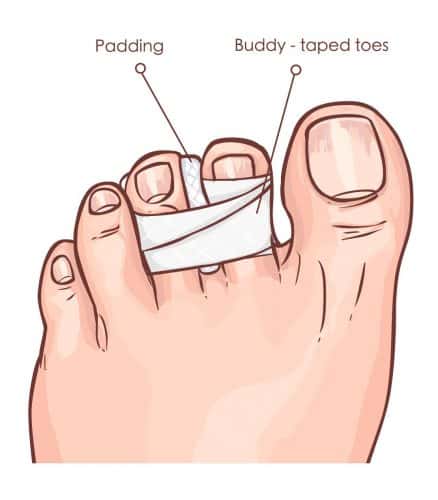
In general, heel weight-bearing is allowed, avoiding toeing-off on the affected side when walking.  It is advisable to rest your foot, keep it elevated, and to apply ice to the swollen area.  A method called ‘buddy splinting’ is often used, whereby the adjacent toe is bandaged together with the fractured toe, splinting the fractured toe to stabilise it until it heals.

In more severe cases with multiple fractures, an unstable fracture or significant toe deformity, surgery may be required, with the insertion of low-profile metal plates and/or screws to stabilise the fracture and promote healing.

Recovery time is approximately 4-8 weeks, depending on the severity of the fracture and compliance to treatment recommendations.

foot injury doctor - Oxford Orthopaedics

When should I see a doctor for a foot injury?

If you experience persistent foot pain, swelling, or bruising especially after a traumatic injury, do seek medical advice and arrange for an orthopaedic consultation early to provide the best chance for quick recovery and avoiding long term complications.  Your doctor will be able to promptly diagnose your injury and offer the optimal treatment for you to get you back to activity and sports swiftly!

Get in touch

Make an Enquiry or Request an Appointment

Our friendly team is here to serve you. For urgent enquiries and appointment requests, please call or WhatsApp us directly.

Oxford Orthopaedics Logo