

You reach for something on the top shelf and your shoulder simply refuses to obey. You get out of bed and your knees creak before you’ve even had your first sip of coffee. It’s easy to put it down to age or a bad night’s sleep, but working out what’s really behind an ache isn’t always this simple.
These aches are common among women in their 40s and 50s. A National University Hospital study of more than 1,000 midlife women in Singapore found that three in four reported some degree of joint or muscle pain. Chronic pain in midlife is also the theme of this year’s World Menopause Day, on 18 October. Hormonal changes might contribute, but joints also carry the effects of everything they’ve been through over the years.
What Puts Strain on Your Joints in Midlife?
Three things commonly put strain on joints in midlife: years of use, old injuries, and weaker muscles. Their effects tend to accumulate rather than arrive all at once. Over decades of use, the cartilage that cushions the ends of our bones can gradually wear down, and this can lead to osteoarthritis. In this type of arthritis, joints become painful, stiff, and sometimes swollen, most commonly in the hands, hips, knees, and spine.
An old injury can add to this, even if it healed long ago. A damaged cartilage, a fracture through the joint surface, or a torn ligament can leave the joint less stable or cause it to bear weight unevenly, which makes osteoarthritis more likely to develop there years later.
The muscles around a joint also protect it by absorbing impact and keeping it stable. This protection lessens as muscle mass and strength begin to decline, a change that starts in our 30s or 40s and can progress to sarcopenia, especially without regular strength training. The joint is then left to take on more of the force. Weak thigh muscles, for example, soak up less of the shock each time the foot lands, so more of it passes through the knee.
All three affect men and women alike. In women, these changes often build up over the same years as menopause, which raises the question of whether it adds to the strain.
How Does Menopause Cause Joint Pain?
Menopause itself is a single point in time, confirmed once 12 months have passed without a period. In Singapore, women reach it at around 49 on average, but the hormonal changes behind it begin years earlier, during perimenopause. This transition usually starts in the 40s and lasts around four years on average, with oestrogen levels rising and falling unpredictably before declining.
This matters for joints because oestrogen is thought to help protect them. It plays a role in keeping inflammation in check and is involved in maintaining cartilage, as well as the collagen in tendons and ligaments. As oestrogen levels fall, joints might lose some of this protection, which could leave them feeling stiffer and achier. Joint pain (arthralgia) associated with these hormonal changes often manifests as:
- Stiffness first thing in the morning or after sitting
- Aches in the hands, knees, hips, or neck
- Pain that moves around rather than staying in place
Even so, hormones are rarely the only factor. Some of these signs, especially morning stiffness, also occur with osteoarthritis, and the two can develop side by side in midlife, which is what makes joint pain so tricky to read.
Why Is It Hard to Tell What’s Causing Your Joint Pain?
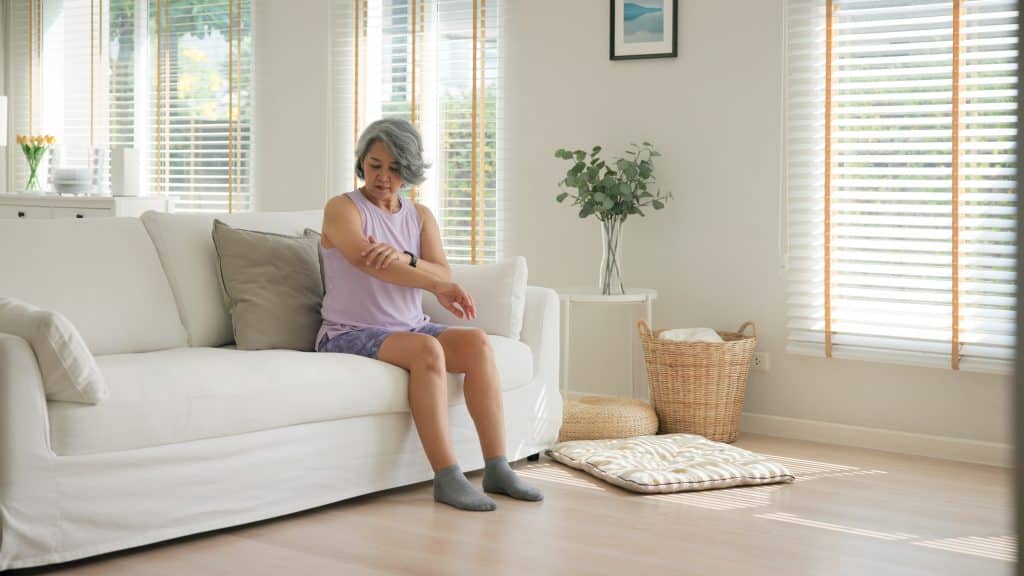
In midlife, wear, old injuries, weaker muscles, and hormonal changes rarely take turns. A single knee might carry an old injury, early cartilage wear, and the effects of falling oestrogen all at once, and because each can cause similar stiffness and aching, the feeling alone seldom reveals which one is responsible.
The pattern of pain can offer some clues. Osteoarthritis usually stays in the same joints and worsens gradually, whereas hormonal aches tend to shift from one joint to another. When both are at work, these patterns can blur.
Similar symptoms can even come from entirely different conditions, as a stiff, painful shoulder shows. Falling oestrogen might play a part in frozen shoulder, where the capsule surrounding the shoulder joint thickens and tightens, making the shoulder painful and hard to move. Because it’s most common between 40 and 60, and affects women more often than men, a stiff shoulder in midlife can easily be attributed to it. But a rotator cuff tendon problem or shoulder arthritis can cause similar pain and restricted movement, and each needs a different approach.
Some causes also feed into each other. Weight gain is common around menopause, and it adds to the pressure on weight-bearing joints like the hips and knees. This can create a frustrating cycle: pain makes it harder to stay active, less activity can lead to further weight gain and muscle loss, and the joints end up bearing more load with less support, so they ache even more.
Joint pain in midlife is common, but it isn’t something you have to quietly live with. This World Menopause Day, if aches are affecting your daily life, speak to an orthopaedic specialist, who can work out which causes are involved and what might ease them.
How Can an Orthopaedic Specialist Help With Joint Pain?
An orthopaedic assessment narrows this down by looking past the pain itself to the joint, checking whether the cartilage, bone, tendons, ligaments, or joint capsule are involved. Because similar aches can come from any of these, knowing which are affected helps guide treatment, whether the aim is pain relief, better movement, or long-term protection of the joint.
At Oxford Orthopaedics, this begins with a review of how your symptoms began and your medical history, including any changes you’ve noticed around menopause, followed by an examination of how far the joint moves, on its own and with assistance, and how stable it is. Where further investigation is indicated, imaging such as X-rays or an MRI scan can show what’s happening in the bone, cartilage, and surrounding soft tissues, and if an inflammatory cause is suspected, blood tests might also be arranged. With a clearer diagnosis, our doctors can then advise on the approach best suited to your joint. So if pain or stiffness is still limiting your movement or the activities you enjoy, please contact the clinic to book an appointment.
