
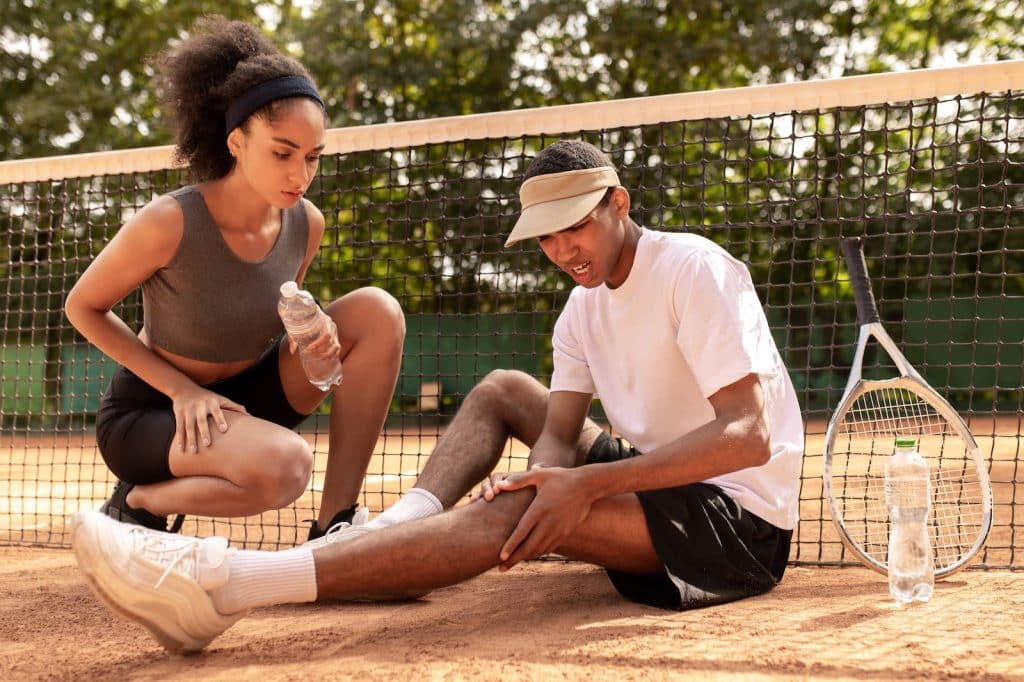
When people think about where tennis places the most strain on the body, the shoulder, elbow, and wrist often come to mind first. Yet the knees are working throughout every point too. Sprint for a drop shot. Brake hard, plant your foot, and pivot. Then push off in the opposite direction. On a tennis court, your joints might have to manage all of this within a matter of seconds, before the sequence begins again with the next rally.
When the sequence is repeated at speed, substantial force can pass through the knee, with injury affecting different structures within the joint. Professional tennis offers clear examples. At Wimbledon in July 2023, Venus Williams fell during her first-round match and later revealed that the knee injury involved cartilage damage. At Roland Garros in May 2026, Hailey Baptiste sustained an anterior cruciate ligament (ACL) tear together with meniscus injuries after landing during a point. One involved cartilage, while the other affected the ACL and menisci, illustrating how varied knee injuries in tennis can be.
Although these examples come from professional tennis, the same basic movement patterns are present at recreational level, even if the speed and intensity are lower. To understand why knee pain can develop during or after play, it helps to first look at what the knee is being asked to do on court.
What Does Tennis Demand from Your Knees?
During a rally, forces from the ground and your own momentum travel through the lower limb. The knee forms part of this kinetic chain, helping to absorb and transmit load while maintaining control as you reposition for the next shot.
Yet the amount of force involved is only one part of how the knee is loaded. How that force acts on the joint matters too. In other words, it isn’t just about the sheer amount of force involved. Some loading can also take the form of shear force, which creates a tendency for the joint surfaces to move relative to one another. Rotational loading can occur at the same time, which means the knee might have to manage forces acting in more than one direction.
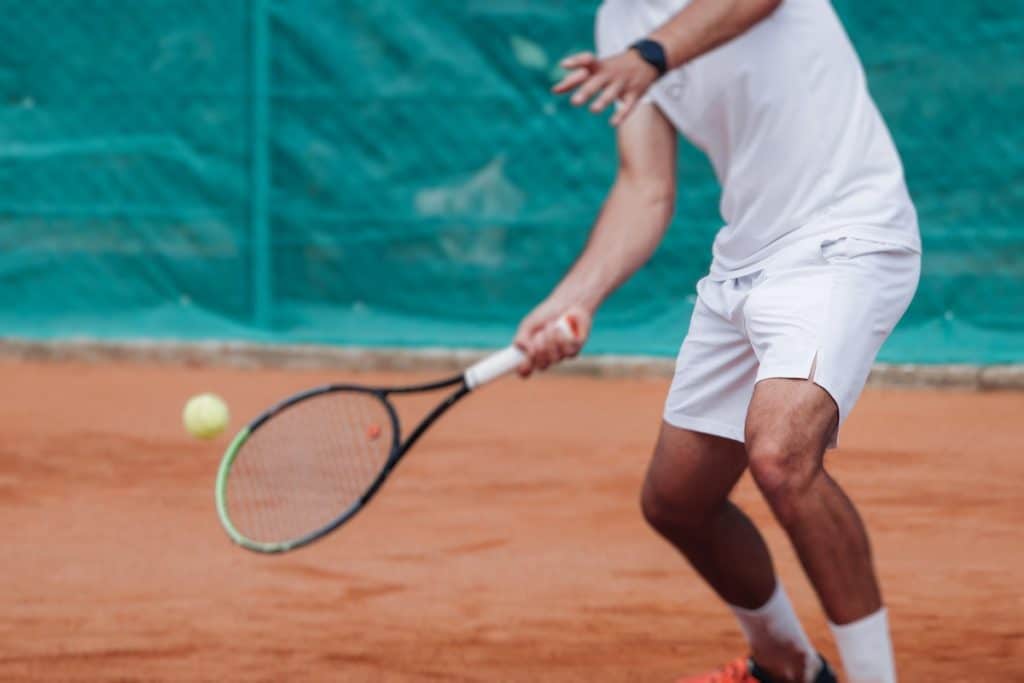
Frequency matters as well. Throughout play, the knee encounters these mechanical demands repeatedly. Sometimes a problem can be traced to one identifiable incident on the court. In other cases, symptoms emerge progressively without a single obvious moment of injury. This difference in onset provides a useful way to understand the knee injuries and problems associated with tennis.
How Can Knee Problems Develop in Tennis?
Whether knee pain follows a specific movement or develops gradually over time can offer useful clues about what might be causing it. For example, a sharp pivot or landing raises different possibilities from discomfort that becomes more noticeable over several sessions or as playing volume and intensity increase.
Knee Injuries That Can Happen Suddenly
During some movements on court, several forces can act through the knee at once. If the stress exceeds what a particular structure can tolerate, an acute injury might occur. The ACL and meniscus are two examples of structures that can be affected.
- ACL injuries – The ACL helps stabilise the knee by limiting excessive forward movement and helping control rotation. During rapid deceleration or an abrupt change of direction, the shear and rotational loading discussed earlier can increase strain on the ligament. If that strain becomes too great, the ACL can tear, even without direct contact.
- Meniscus injuries – The menisci are fibrocartilage structures that help distribute force across the joint and contribute to stability. A tear can occur when the knee rotates while bearing weight, particularly if the foot remains planted as the body changes direction.
Knee Problems That Can Develop Gradually
With gradual onset problems, cumulative loading becomes more important than one particular incident. Over time, the balance between how much the knee is being asked to do and how well the tissues adapt and recover can influence whether symptoms develop.
- Patellofemoral pain – Commonly known as runner’s knee, this usually causes discomfort around or behind the kneecap and often becomes more noticeable when the knee repeatedly bends while bearing load. Although the name is associated with running, similar demands occur in tennis during deep lunges, low volleys, and repeated movement around the court, all of which can increase the load through the front of the knee.
- Patellar tendinopathy – Often called jumper’s knee, this affects the patellar tendon just below the kneecap and is associated with repeated high load activity. In tennis, the name is particularly relevant to movements such as jumping, but the tendon is also loaded during explosive push offs and rapid changes of direction. When these are repeated frequently during training or play, the tendon can become overloaded over time.
Whether a knee problem follows one clear movement or builds over time can therefore help narrow the possibilities. Even so, different conditions can develop in similar ways, so how the problem began might not always make the cause clear. The symptoms that accompany the pain can then help narrow the possibilities further.
What Symptoms Can Point to a Knee Injury?
A sore knee after playing tennis doesn’t necessarily mean the knee is injured. Some discomfort can follow a particularly demanding session, especially if you have played longer or more intensely than usual. What matters more is whether it settles with recovery or continues to affect you afterwards.
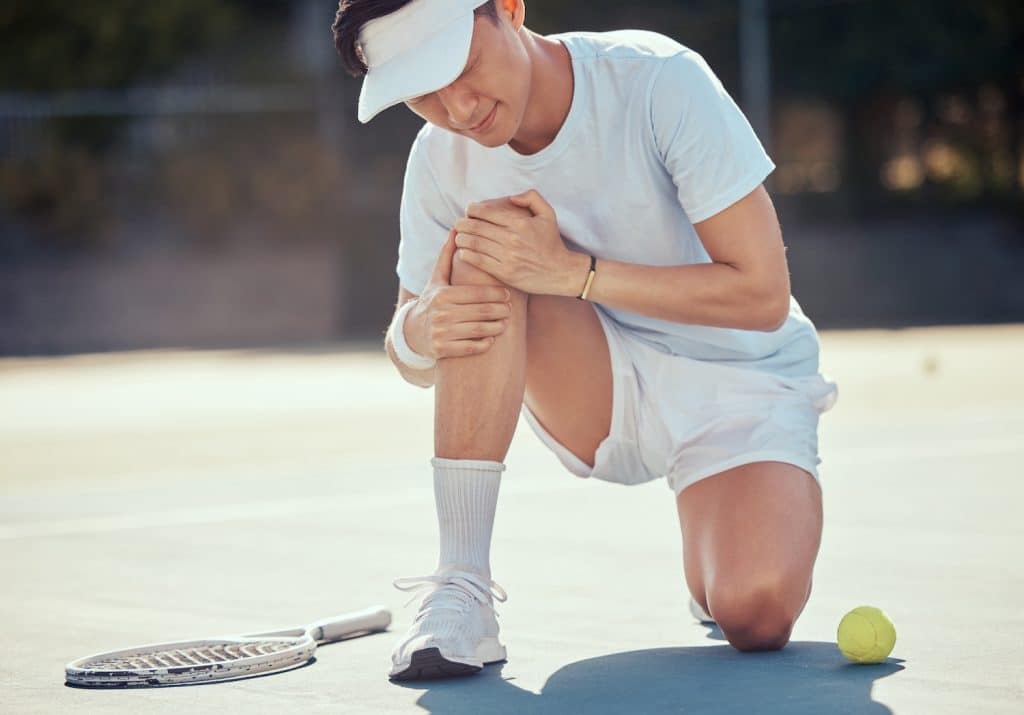
Some symptoms to pay closer attention to include:
- Persistent or worsening pain – Pain that doesn’t settle between sessions, keeps returning during play, or becomes more noticeable over time might suggest that the knee hasn’t recovered as expected.
- Stiffness or reduced movement – The knee might feel tight or lose some of its usual range of movement, making it harder to bend or straighten fully. This can affect movement on court and during everyday activities.
- Catching or locking – Movement might be interrupted by a catching sensation, or the knee might occasionally become locked in a position. Repeated episodes might suggest a mechanical problem within the joint.
- Instability or giving way – The knee might feel unreliable or as though it could buckle when walking, running, or changing direction. This can occur when structures involved in stabilising the joint are affected.
Alongside these symptoms, swelling can also develop when excess fluid collects within the knee joint, a condition known as a knee effusion. At Wimbledon in 2026, Serena Williams injured her right knee during her opening round singles match, after which significant fluid built up within the joint and was later drained. She subsequently withdrew from the women’s doubles, where she had been due to partner her sister Venus Williams. While Venus was mentioned earlier in relation to cartilage damage, Serena’s separate experience shows another way knee problems can present in a sport that places considerable demands on the joint.
For recreational players, the same principle applies: what matters is whether symptoms settle with recovery or continue to interfere with movement. If any of the symptoms above start to affect how you move on or off court, it might be worth having your knee checked by an orthopaedic specialist with experience in sports injuries.
When Should I See a Doctor for Knee Pain After Tennis?
By this point, the more useful question isn’t simply whether your knee hurts after tennis, but whether it’s recovering as expected. If pain keeps returning, swelling doesn’t quite settle, or symptoms such as locking or instability start affecting movement, the knee might need a thorough review.
At Oxford Orthopaedics, an assessment can help clarify which structures are involved and whether imaging is needed to confirm the diagnosis or extent of injury. Dr Lester Tan can then advise on the treatment approach best suited to the injury and your recovery goals. If knee pain continues to affect everyday movement or your return to tennis, please contact the clinic to book an appointment.
