
Every FIFA World Cup has a way of pulling people back towards football. For many, it brings back the urge to lace up, join a friendly match, or return to a sport they once played regularly. That excitement is part of what makes football such a beautiful game, but from an orthopaedic perspective, it also comes with a familiar concern.
Over the years in my practice as a foot and ankle orthopaedic specialist, football related injuries have been among the common sporting injuries I see in clinic. Many of these injuries don’t happen because a person is unfit in general. Rather, they happen because the foot and ankle haven’t been gradually prepared for the specific demands of football.
Who Is Most at Risk When Returning to Football?
Two groups stand out. The first is players who haven’t conditioned their bodies for football. The second is older players who are returning to the game after time away, or trying to keep playing at the same intensity as before.
This matters because conditioning takes time and consistency. Tendons, muscles, ligaments, and bones need repeated loading to adapt to sport, and this adaptation cannot be rushed. In many cases, meaningful conditioning requires around three months of regular training1,2.
Age adds another layer to this. As we get older, tendons and ligaments tend to become less elastic, while age related changes in blood flow around the Achilles tendon can also affect how well these tissues respond to exercise and recovery³. This doesn’t mean older players should avoid football. However, it does mean the body usually needs more preparation, not less.
Why Football Injuries Happen When the Body Isn’t Ready
Football places repeated stress on the foot and ankle through sprinting, stopping, twisting, pivoting, jumping, landing, and tackling. These movements are part of the game, but they also ask the ligaments, tendons, bones, joints, and supporting muscles around the foot and ankle to absorb load quickly and repeatedly.
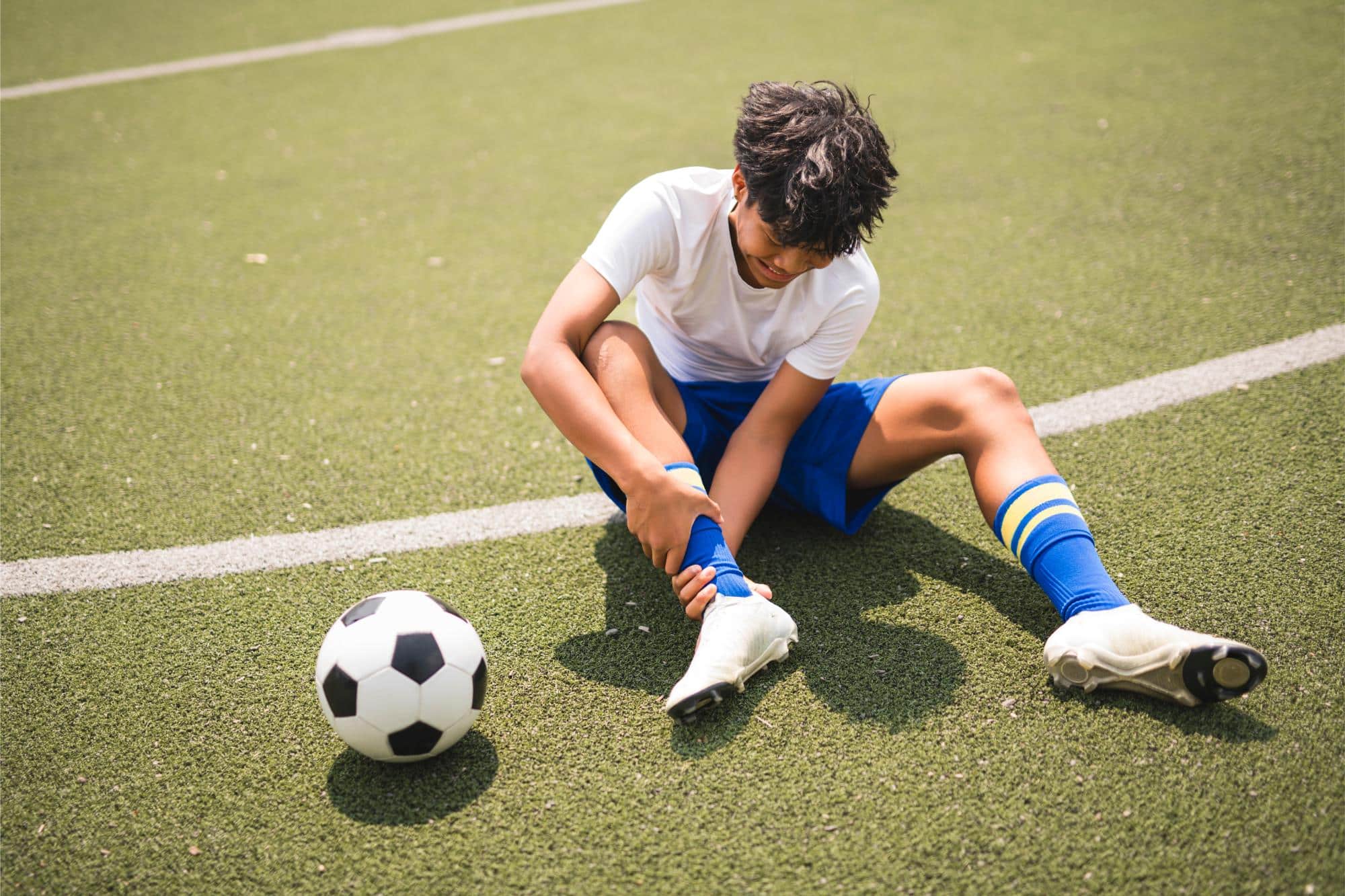
Ligament injuries are often linked to sudden twisting, rolling, or awkward landing movements. This is why ankle sprains are common in football, especially when the ankle is forced beyond its usual range of control. In some players, repeated sprains can lead to ongoing ankle instability.
Tendon problems can occur when the foot and ankle are repeatedly loaded during sprinting, pushing off, and changing direction. The Achilles tendon, peroneal tendons, and other stabilising tendons around the ankle help control these movements. When these tissues aren’t conditioned for football, tendinopathy or more significant tendon injury can occur.
Bone and joint injuries can happen in two main ways. A tackle, collision, awkward landing, or being stomped on can cause an acute fracture. Repeated running and loading can also contribute to stress injuries in the foot or ankle. Direct trauma to the forefoot might occasionally result in a traumatic bunion injury, while significant sprains or repeated instability can affect the ankle joint surface or cartilage.
This is why a player might feel generally fit, but still be underprepared for football. Jogging, gym work, or casual exercise can help overall fitness, but football places specific demands on the foot and ankle that need to be built up gradually.
How to Prepare Yourself Before Returning to the Pitch
A bit of planning, patience, and discipline goes a long way. If you’re returning to football after time away, it’s sensible to give your body around three months of conditioning before returning to full intensity.
A well-rounded programme should include ankle mobility, foot control, balance work, Achilles conditioning, tendon loading exercises, and sport specific movement practice. Together, these help the foot and ankle tolerate running, cutting, landing, pivoting, and pushing off during play.
Before every session, a proper warm up is also important. A light jog followed by dynamic stretching is generally recommended before football because it prepares the body for repeated sprinting and explosive movement⁴.
In contrast, prolonged static stretching before explosive sport can impair performance⁵. The aim isn’t just to feel loose. The aim is to prepare the body for the sudden acceleration, deceleration, landing, twisting, and pivoting that football requires.
What If You Already Have an Existing Injury?
If your ankle feels unstable or painful, whether during play or simply while walking on flat or uneven ground, it’s worth having it assessed by an orthopaedic specialist. This can help determine whether there’s underlying ligament instability, and whether other structures are also involved.
The assessment is important because recurrent ankle sprains aren’t always isolated ligament problems. The ankle tendons, joint surface, cartilage, or surrounding bones can also be affected, especially when symptoms persist or the ankle keeps giving way.
Foot shape can also influence the risk of repeated sprains. For example, a high arch can place the ankle in a position that makes rolling or twisting injuries more likely. Less commonly, a childhood condition called tarsal coalition, where certain foot bones are joined together, can increase strain on the ankle ligaments and tendons.
Where these issues are identified, treatment often begins with structured rehabilitation. This usually involves working with a physiotherapist to rebuild ankle strength, coordination, balance, and confidence during sport specific movement.
However, should symptoms persist despite appropriate rehabilitation and the patient still wants to remain active, surgical options can be discussed where suitable. This decision should be based on the severity of instability, the structures involved, the patient’s activity goals, and how the ankle responds to rehabilitation.
As for those without significant pain or instability who simply want additional protection, an ankle brace can be useful. Laced or semi rigid ankle braces are supported by research. When worn during play, they can help offload the ankle ligaments during twisting and pivoting movements, and external ankle supports have been shown to reduce the risk of ankle sprains in sport⁶.
Taping is another option, although it tends to loosen with sweat and movement over time. For that reason, bracing is generally more reliable over the course of a game.
Staying in the Game Starts with Preparation
The goal isn’t to make people fearful of football. The goal is to help them enjoy the sport with fewer avoidable foot and ankle injuries. Football is intense, even when played recreationally, and the body needs time to adapt to that intensity.
If you’re planning to return to the pitch, give yourself time to prepare. If ankle pain, swelling, instability, or repeated sprains keep returning, seek professional advice before pushing through. There’s no quick fix or shortcut when you want to enjoy the beautiful game, but with planning, patience, and the right support, more players can stay active for longer.
Looking for a Foot & Ankle Specialist for Football Injuries?
Because football places repeated stress on the foot and ankle, persistent pain, swelling, instability, or recurrent sprains shouldn’t be dismissed as normal soreness. These symptoms can involve the ankle ligaments, tendons, joint surface, cartilage, bones, or the structure of the foot itself, so treatment has to be judged on a case-by-case basis. At Oxford Orthopaedics, a focused consultation can help assess the wider clinical picture, determine whether there’s an underlying foot or ankle injury, and guide the approach best suited to the patient’s condition, activity level, and return to sport goals. To arrange for a consultation with Dr James Siow, please contact the clinic to book an appointment.
References
- Reeves ND, Maganaris CN, Narici MV. Effect of strength training on human patella tendon mechanical properties of older individuals. J Physiol. 2003;548(Pt 3):971-981.
- Radovanović G, Bohm S, Peper KK, Arampatzis A, Legerlotz K. Evidence-Based High-Loading Tendon Exercise for 12 Weeks Leads to Increased Tendon Stiffness and Cross-Sectional Area in Achilles Tendinopathy. Sports Med Open. 2022;8(1):149.
- Langberg H, Olesen J, Skovgaard D, Kjaer M. Age related blood flow around the Achilles tendon during exercise in humans. Eur J Appl Physiol. 2001;84(3):246-248.
- Aouadi R, Ltifi MA, Ceylan Hİ, Jlid MC, Bragazzi NL. Superiority of Dynamic Stretching over Static and Combined Stretching Protocols for Repeated Sprint Performance in Elite Male Soccer Players. Sports (Basel). 2025;13(8):275.
- Haddad M, Dridi A, Chtara M, Chaouachi A, Wong del P, Behm D, Chamari K. Static stretching can impair explosive performance for at least 24 hours. J Strength Cond Res. 2014;28(1):140-146.
- Dizon JM, Reyes JJ. A systematic review on the effectiveness of external ankle supports in the prevention of inversion ankle sprains among elite and recreational players. J Sci Med Sport. 2010;13(3):309-317.
