
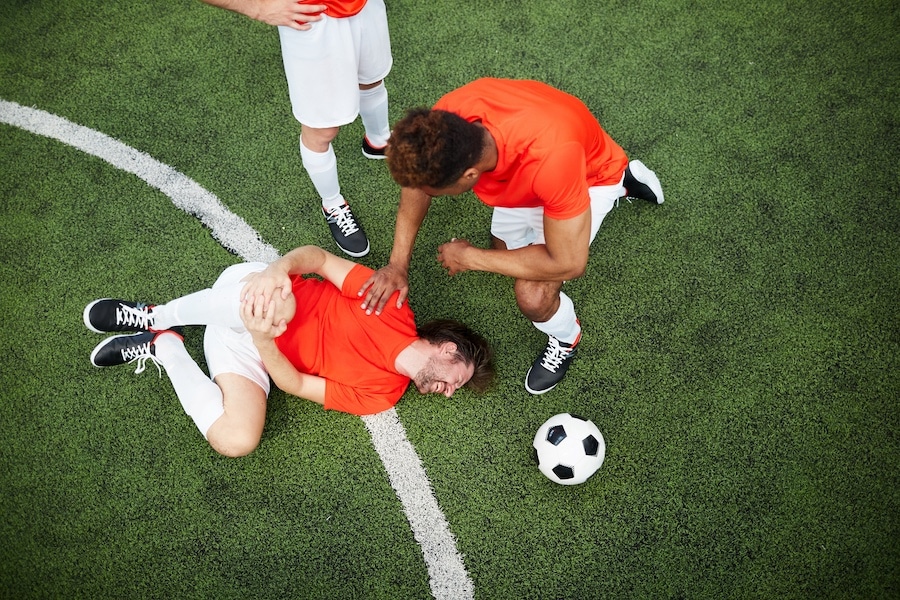
The FIFA World Cup is over, but for several of the game’s established names, it ended before it began. In the closing months of last season, anterior cruciate ligament (ACL) injuries cost Real Madrid’s Rodrygo, PSV Eindhoven’s Jerdy Schouten, and Tottenham Hotspur’s Xavi Simons their places at the tournament. Less than three months into the new European club season, the same injury has claimed another high-profile casualty in Khvicha Kvaratskhelia, a Ballon d’Or nominee who was central to Paris Saint-Germain’s (PSG) back-to-back European titles. During PSG’s 4–2 UEFA Champions League win over Barcelona on Tuesday, 20 October 2026, he twisted his right knee in a challenge with defender Xavi Espart and was helped off in the 59th minute, unable to put weight on his leg.
Away from the headlines, the same can be true for recreational footballers, whose games involve similar sprints, turns, and landings. The difference lies in what surrounds these movements, as many of them don’t have the conditioning programmes, structured warm-ups, and medical oversight that professional clubs provide. If players with this level of support can still rupture an ACL, those with less behind them might be more vulnerable. For them, the consequences can reach well beyond football, because a completely torn ligament rarely heals by itself, and the months of recovery that follow can also affect work and daily movement. Why a single movement can lead to all of this comes down to what happens inside the knee when the foot stays planted while the body keeps moving.
Which Moments in Football Put the ACL Under Strain?
In football, turns, sudden stops, landings, and off-balance kicks all load the knee over a planted foot, which is why most ACL tears occur during a player’s own movements rather than from a direct blow in a tackle. The great majority of these movements pass without harm, so whether someone is left balled up in pain often depends on the knee’s position and how quickly the force builds.
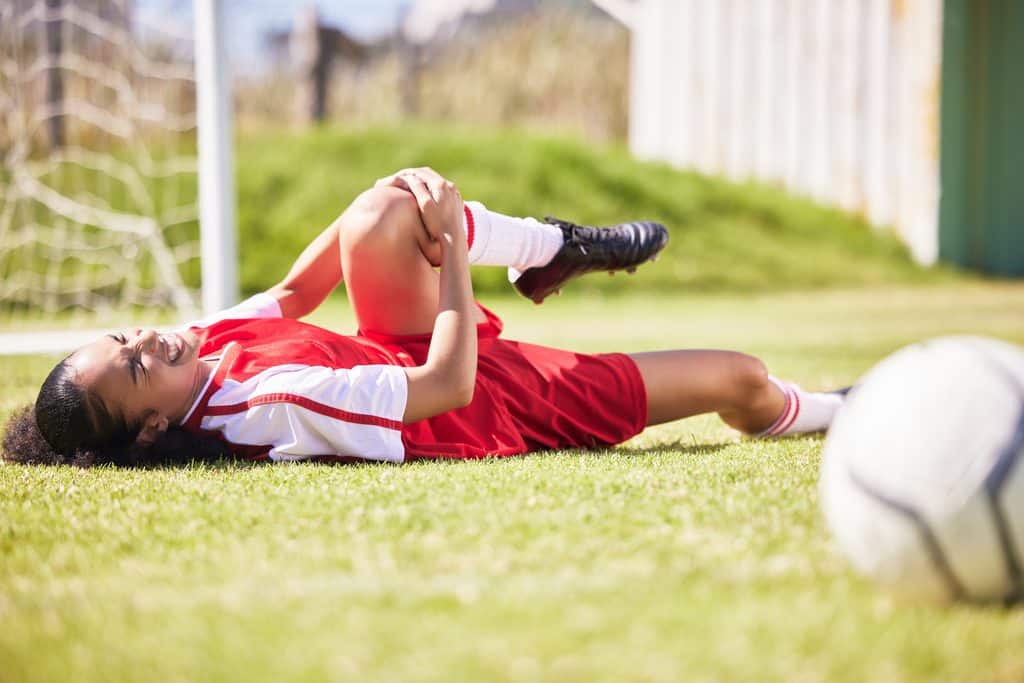
Planting the Foot to Pivot or Cut
Pivoting or cutting anchors the foot while the body swings round above it, twisting the knee under the player’s weight. Since the ACL helps control this rotation, the strain on it grows when:
- The player changes direction at speed on reflex.
- The foot plants with the knee nearly straight.
- The knee caves inward towards the other leg.
Stopping Suddenly at Speed
To slow the body quickly, the quadriceps at the front of the thigh contract hard, and this can pull the shin forward against the ACL. The load on the ligament rises when:
- The player makes a sudden dead stop from a full sprint.
- The knee stays fairly straight throughout the braking.
- A sharp turn follows right after the stop.
Landing from a Jump or Header
As the player returns to the ground, the body’s weight drives down through the knee, and the impact can push the shin forward, loading the ACL. The risk to the ligament grows when:
- A mid-air challenge knocks the player off balance.
- The player comes down on one leg only.
- The knee barely bends as the foot lands.
Regaining Balance after a Kick
A hard strike carries the body forward and round, so once the ball has gone, whichever leg holds the body up has to halt this momentum on its own.
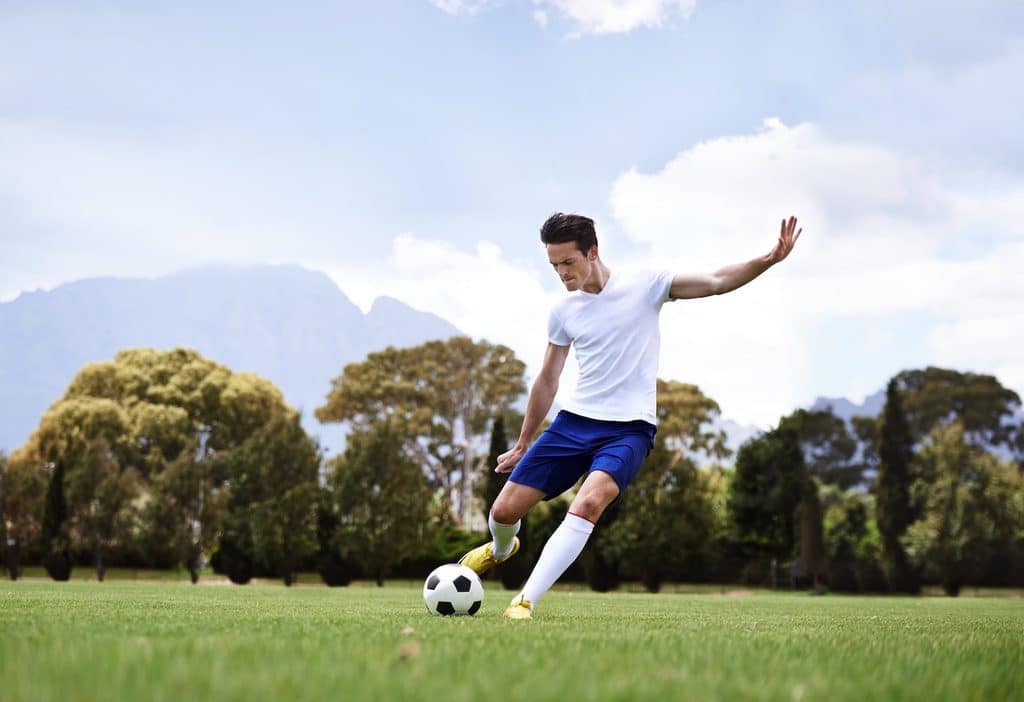
The ACL is most exposed when:
- The player meets the ball at full stretch.
- An opponent bumps the player during the strike.
- The knee drops inward as the player steadies.
Taking a Blow in a Tackle
A blow from an opponent can force the knee inward and twist it in one motion, sometimes tearing the ACL along with the medial collateral ligament (MCL) on the joint’s inner side. This is more likely when:
- The player goes into a 50-50 block tackle.
- The challenge hits the outside of the knee.
- The studs are still fixed in the ground.
When the ACL does tear, many hear or feel a pop in the knee. Some, like Kvaratskhelia, can’t bear weight on the leg afterwards, but others are able to walk off unaided, even with the ligament torn.
Why Can You Still Walk Off the Pitch with a Torn ACL?
Walking in a straight line involves little twisting of the knee or forward pull on the shin, the two movements the ACL helps restrain. With this lighter load, the posterior cruciate ligament (PCL) behind the ACL, the MCL, and the lateral collateral ligament (LCL) on the outer side can usually keep the knee steady if they’re intact, with help from the joint capsule and surrounding muscles. In the early days, walking is limited more by pain and by swelling, which often builds within hours, than by the tear itself. As the swelling eases over the following weeks, walking might start to feel normal again, tempting you back onto the pitch even though the knee has lost the ACL’s control.
What Happens If You Keep Playing on an Unstable Knee?
Not everyone is Zlatan Ibrahimović, so humans shouldn’t have the audacity to compare themselves to a lion. But we jest. In all seriousness, his decision to play on for six months without an ACL in his left knee is hardly one to copy. He revealed this in May 2022, days after helping AC Milan win the Scudetto, describing a knee that stayed swollen throughout, with excess fluid (effusion) that had to be drained once a week. Alongside the drainage, he needed regular injections and daily painkillers just to keep going, and he barely trained with the team. Yet at 40, he still played his part in Milan’s title. Pulling this off depends on strong muscles, particularly the hamstrings, taking on some of the missing ACL’s work, and few footballers are conditioned well enough for it. Even at this level of fitness, he required reconstruction surgery after the season ended.
No amount of conditioning can fully replace the ACL though. No matter how well-trained they are, muscles can only help steady the knee, but they can’t hold the shin in place as reliably as the ligament did. As a result, the shin might still slip forward or twist during sudden cuts, pivots, or stops, causing the knee to give way. Each time this happens, abnormal pressure falls on the menisci, two shock-absorbing pads between the thigh bone and shin bone, and on the smooth (hyaline) cartilage covering the ends of these bones. Over time, this repeated pressure can cause new meniscus tears or enlarge any left by the original injury. Cartilage damage tends to build up in the same way, raising the risk of knee osteoarthritis (OA) later in life. Avoiding these problems starts with knowing whether the ACL is torn. However this isn’t always obvious, as other knee injuries can also cause swelling and weakness.
Not Sure Whether Your Knee Injury Involves the ACL?
Uncertainty after a knee injury happens even at the top level. Alan Shearer tore his right ACL against Leeds United on Boxing Day 1992, yet scored twice in Blackburn Rovers’ 3–1 win and, by his own account, only discovered the tear in hospital weeks later. If a player of his calibre could miss it, waiting to see whether your knee holds up in a game is far from a reliable test. Having it assessed before you play again gives a clearer answer and can also help rule out other knee injuries that feel similar.
At Oxford Orthopaedics, this assessment can help clarify whether the ACL is torn and if other parts of the knee, such as the menisci or cartilage, are also affected. These findings can then be confirmed with imaging such as an MRI, which also shows the extent of the injury. With a clear diagnosis, Dr Lester Tan can advise on the treatment approach best suited to your knee, activity level, and goals for returning to football. If your knee keeps giving way or you’re still unsure whether the ACL is involved, please contact the clinic to book an appointment.
